Tag: PGP

  • June Blog!

    June Blog!

    Welcome! 

    Welcome back to the PGP blog. In this blog post, you will find some suggestions for some tiny signs of Summer you may spot when out in nature this June, the best places to find them and some playful suggestions for free activities to help you and the little people in your life feel closer to the green spaces around you.

    What might you spot in June?

    We are now moving into the summer season, and days are getting warmer and longer. Why not take advantage of the lighter evenings and go for a nature walk around your local area after dinner? Recent research has suggested that time spent with parents in nature appears to positively impact children’s sleep quality (Kokkonen et al., 2021), meaning the added bonus of more rest for the whole family!

    Elderflower

    The Elder tree (Sambucus Negra) is a native and widespread small tree. Hugely resilient, you will find Elder growing in a variety of habitats; in fact, it is known to thrive almost anywhere and to grow very quickly. With its abundant and tasty blossoms in Spring, its delightful berries in early Autumn and its branches which were historically used in fire lighting, it comes as no surprise that Elders hold a prominent position in Folklore across Ancient Europe. Commonly associated with major goddesses and fairy communities in many Pagan traditions, Elder is frequently understood to symbolise rebirth and renewal.

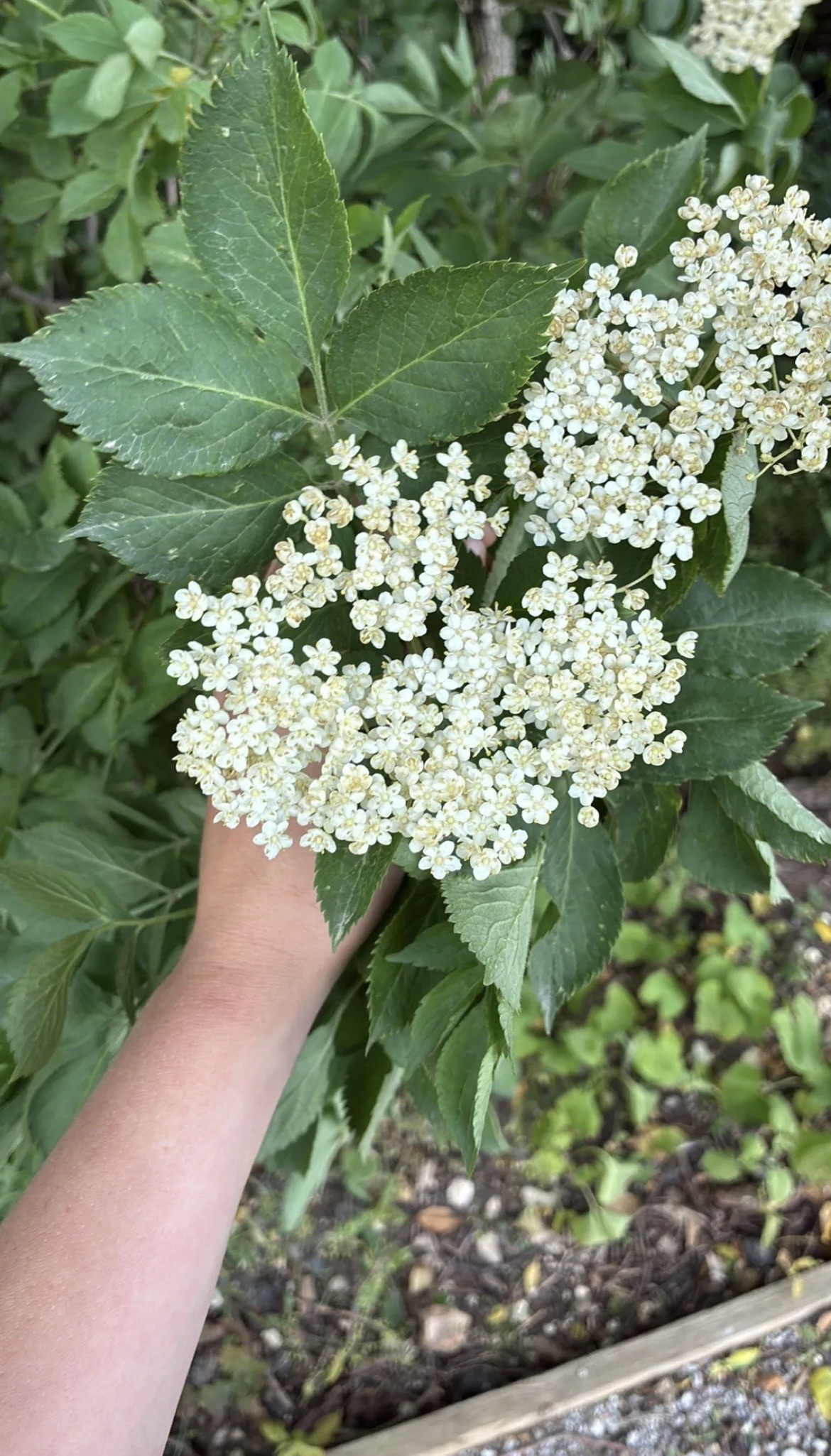
    The delicate flavour of Elderflower makes it a popular choice for foragers, and you can follow our recipe below to make a refreshing summer cordial for all the family to enjoy. When foraging for elderflower, take care not to pick all your blooms from one tree, making sure to leave some for pollinators. You can recognise Elder trees by observing the leaves, which grow in sets of five. You can also look at the shape of the blossoms, which grow in tight, flat clusters of five-petalled cream-coloured flowers. The strong and distinctive scent of the Elderflower blossoms also aids identification.  


    June’s nature connection activity – Elderflower syrup

    Now is the perfect time to make this delicious summery syrup, which can be used as a cordial by mixing with water, as well as to flavour cakes and desserts. This would also make a lovely seasonal gift for a friend or family member. Just make sure a grown-up is on hand to help!

    You will need:

    • 15 heads of elderflower
    • 500g sugar
    • 1 lemon
    • 1 litre of fresh boiled water

    ← Back

    Thank you for your response. ✨

    Rate this activity(required)

    Instructions

    Debug your blooms:To rid your elderflower of any creatures who may be sheltering in them, spread a sheet of paper on a table (preferably outside). Prop your container of flowers upside down over the paper; any insects will then crawl out towards the light and remain unharmed. You may also wish to rinse your blooms. However, doing so will reduce the flavour of your syrup slightly. 

    Make the syrup:Bring the water and sugar to a simmer in a large pan. Add the elderflower and lemon slices (we also added some rose petals for a subtle floral flavour). Leave this to continue simmering for 30 minutes.

    Infuse:Turn off the heat and allow the mixture to steep for a further 4 hours to let the flavour develop.

    Strain and bottle:Place a clean tea towel in the bottom of a colander and place this over a clean container. Strain the mixture through, you should now have a clear, golden liquid. Decant into sterilised bottles/jam jars and label.

    Enjoy!This syrup should keep for a couple of months in the fridge.


    PGP Hull Diary: What’s happening next? 

    Wave and Willow Wednesday sessions:

    Wave and Willow run weekly sessions for home-educated children at our site in the Botanic Gardens every Wednesday, from 1-3 pm. All sessions are £10 per child. To book, please message Tasha on +44 (0)7788 405093


    References:

     Kokkonen, J. M., Vepsäläinen H, Abdollahi A, Paasio H, Ranta S, Erkkola M, Roos E, Ray C.  (2021) ‘Associations between parent-child nature visits and sleep, physical Activity and weight status among Finnish 3-6-year-olds’, International Journal of Environmental Research and Public Health, 18(23), p. 12426. doi: 10.3390/ijerph182312426.

  • April Blog – Buds, Bees and Bluebells!

    April Blog – Buds, Bees and Bluebells!

    Welcome! 

    Welcome back to the Playful Green Hull blog.

    In this post you will find some suggestions for some tiny signs of Spring you may spot when out in nature this April, the best places to find them and some playful suggestions for free activities to help you and the little people in your life feel closer to the green spaces around you.  

    What might you spot in April? 

    We are now in the middle of the Spring season, and signs of new life and colour are all around us. When out and about with your little ones, here are some of the April treasures you might be able to spot together.   

    As the nation’s favourite wildflower, bluebells (Hyacinthoides non-scripta) are a popular native species. Usually appearing in woodlands around the first half of April, around half of the world’s population of bluebells are resident to the UK! The vibrant blue of these flowers along with their distinctive and delicate ‘bell’ shaped petals and sweet scent make bluebells one of the most loved Spring spectacles that nature offers us. There are many examples of local and regional folklore centred around bluebells; commonly believed to be used by the fairy folk as tiny bells to call fairy gatherings, take care to listen extra carefully when in a bluebell wood! To see these magical flowers for yourself, head down to Burton Bushes in Beverley Westwood. Please remember that, as a protected species, it is illegal to pick Bluebells.  


    Generally considered a weed, the common dandelion (Taraxacum Officinale) is a powerhouse for Spring pollinators and increasing biodiversity in urban environments. Dandelions flower across the whole year, but peak flowering occurs from April to June. You should be noticing these distinctive spots of sunny yellow popping up on grass verges, in parks and, of course, in your back garden! Whilst lots of effort is spent on trying to kill these plants using pesticides, dandelions are an excellent source of nutrition for humans too, with the whole plant (roots, petals and leaves) being deliciously edible and high in vitamins. Please note that, due to the amount of pesticides used on them, it is best to forage for these plants in your own back garden, a friend’s  


    April’s nature connection activity – Dandelion paint 

    You will need:  

    • Dandelion flowers 
    • Pestle and mortar/something heavy for crushing 
    • Hot water 
    • Paintbrushes and paper 

    ← Back

    Thank you for your response. ✨

    Rate this activity(required)

    Instructions:  

    Go for a short walk to any grassy patch close to you, you will find plenty of dandelions! Collect some of the dandelion heads in a bag or basket, remember to leave some for the bees! 

    Use your pestle and mortar (or a rock and a chopping board will also work), to grind the petals into a smooth paste – you may need to help any little ones to apply enough pressure to do this! 

    Add a teaspoon or two of hot water to your petal paste before continuing mixing and crushing the mixture.  

    Once you have achieved the consistency and colour you’re looking for, leave the mixture to settle for about 20 minutes. This will allow your colour to deepen.  

    Have fun creating with your home-made dandelion paint! 


    PGP Hull Diary: What’s happening next? 

    Spring Event: 

    On the 25th of April, we will be hosting our Springtime event down at the Botanic gardens. Please join us with your children for a day filled with nature crafts, storytelling and creative play! You can find more information here:  Upcoming Events

    Earth Day celebration: 

    On the 22nd April we will be celebrating the Earth’s birthday down at the Botanics, joined by children and their teachers we will be learning all about plants and the small creatures who live in the garden. 

    London Marathon mini: 

    On the 30th of April we will be hosting the launch of the Hull Mini Marathon event. We will inviting local settings and schools to join us with their children and learn how to get involved. 

    Maternal Mental Health Week Picnic: 

    We will be hosting a picnic for Maternal Mental Health Week, beginning on the 7th May in collaboration with Together in Nature. Book your FREE place here: Tea Time Family Picnic Tickets, Thursday 7 May  •  16:30 – 18 | Eventbrite

  • Through The Tree Trail: Reporting on our test event

    Welcome back to the PGP blog. This post details our Summer family feast and the launch of our new tree trail. Continue reading to find out more about all the fun we had and see some photos from the event which was a resounding success.

    Tree Trail 

    During the event we launched our new Tree Trail. Visitors to the gardens can now use our map to navigate a path around the site and learn facts both whimsical, historical and scientific about some of our beautiful trees. 

    Apple - There are more than 7,500 varieties of apple trees - one of the facts on our tree skateboards!
    A map of trees on our PGP site including a sweet chestnut, apple tree, magnolia, ash, hawthorn, sequoia and oak.

    Keen observers may also spot some hidden creatures who have taken up residence in their branches so look carefully! Grown-ups and little ones alike loved exploring the site on the day and using the map to make sure they ticked off all the trees. 

    Family Feast 

    Families who attended helped to prepare some delicious food, (much of it homegrown by our star grower Cathy!) and to cook it over our firepit with many of the children using fire lighting flints to get the fire going.

    Plenty of marshmallows were toasted for afters and made into delicious smores – our youngest attendees were particularly enthusiastic about taking part in this activity!

    Our fire pit loaded with food

    Highlights

    Here at Playful Green Hull we are particularly lucky to have a fantastic forest water run on site which inspired an impromptu family water fight! Luckily the weather was on our side and everyone dried off quickly. 

    Families also enjoyed using our bug and minibeast hunting resources to find small creatures who have formed habitats across our site. And it wouldn’t be a Playful Green Planet get together without some very impressive tree climbing! 

    Kids using binoculars
    Kids in a tree

    Save the date! 

    On the 25th of October we will be hosting our official launch event at the Botanic Gardens. This PGP launch event will provide opportunities to set intentions for the Autumn and Winter seasons ahead, with a little help from the local fairies! Families will have opportunities to create magical seasonal crafts, enjoy some cosy Autumnal refreshments and celebrate all that Autumn has to offer through the power of storytelling, song and nature. Come and join us, (spooky) fancy dress encouraged! 

    We are still finalising the details for this event so watch this space to find out more and book your place! 

  • Our first Co-Design Council Meeting

    Our first Co-Design Council Meeting

    Today we were thrilled to host representatives from across the city for our first Co-Design Council Meeting. Our Co-Design Council is our core stakeholder group. They are our coalition of local partners with the expertise, resources and connections to drive the success of PGP in Hull. Attendees included the Friends of Thwaite Gardens, University Estates, THRIVE Cooperative Trust, The Hull & East Yorkshire Children’s University, Hull City Council, Pan Galactic, Rewilding Youth and more!

    Our first meeting focused on developing outdoor learning opportunities for children in Hull, particularly through the use of green spaces like the Botanic Gardens. The aim is to foster confidence in both children and adults, promote safe exploration, and ensure inclusive access to nature.

    Key Themes and Discussions

    1. Access and Inclusion

    • Many families feel disconnected from green spaces due to cost, distance, or perception.
    • The project seeks to reframe nature as a shared, accessible resource.
    • Emphasis on working with children with additional needs in safe, enclosed environments.

    2. Safety and Site Management

    • Importance of clear communication about site features (e.g., maps, photos).
    • Importance of risk assessments, especially regarding chemicals and poisonous plants.
    • Interest in creating child-friendly zones with edible and non-edible plantings.

    3. Educational and Creative Opportunities

    • Integration of science (e.g., biodiversity monitoring, bio blitzes) with creative storytelling (e.g., fairy trails, child lore).
    • Potential for interdisciplinary student projects (e.g., biology and education).
    • Use of artistic approaches to make science more accessible and engaging.

    4. Community and Collaboration

    • Strong desire to involve local communities, schools, and creative practitioners.
    • Discussion of intergenerational learning and community-led development.
    • Interest in linking with existing initiatives like the Children’s University and Eco Fest.
  • RSA formerly launches the Playful Green Planet Network!

    RSA formerly launches the Playful Green Planet Network!

    Today, the RSA is launching the Playful Green Planet Network – a bold new initiative which will roll out nature-based play and outdoor learning across the UK.

    After the success of pilots here (in Hull) and in Dundee, the RSA is aspiring to grow a national movement that empowers communities to transform underused green spaces into imaginative playrooms and outdoor classrooms designed for and with local children.

    We’re super excited to be part of this in Hull – and hope you enjoy checking out the below video from our partners in Dundee and the RSA:

    What is Playful Green Planet?

    Playful Green Planet transforms green spaces into ecologically thriving outdoor playrooms and classrooms that grow children’s (0-11) ecological citizenship.

    Playful Green Planet is committed to growing, connecting and supporting a movement of Playful Green Planet Stewards (from the RSA Fellowship) who are co-creating and co-producing nature-based play and learning experiences for all children and the early years, community and school settings in their neighbourhoods.

    The first new networks of stewards are Redbridge Council’s Fairlop Waters Country Park and Cody Dock’s community gardens in East London. We can’t wait to see what they bring to PGP!